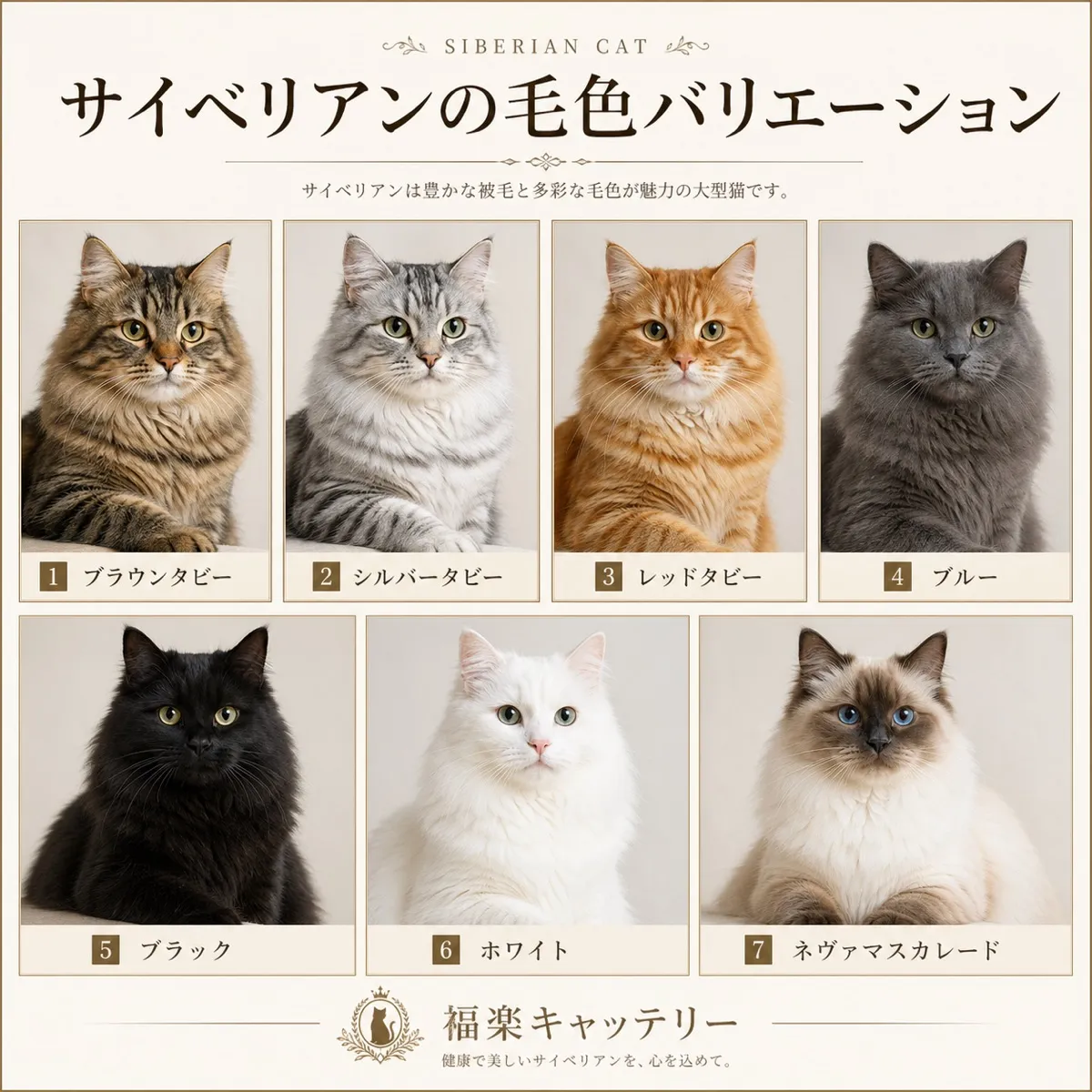
The Complete Siberian Coat Color Guide: Silver Tabby vs. Blue Lynx Point vs. Neva Masquerade
"I've made up my mind on a Siberian—but there are so many coat colors that I just can't decide." Does that sound like you? In truth, the Siberian is a breed recognized in more than 60 color variations, so even two cats that both look like "that grayish kitty" can be surprisingly hard to label—is it a Silver Tabby, or a Blue Lynx Point? In this article, we focus on the three coat colors prospective buyers wrestle with most, walking you through the visual differences along with tendencies in temperament and grooming—all from the perspective of a small cattery in Joto-ku, Osaka, that has sent more than 200 graduate cats off to their new homes.
Silver Tabby: Classic Beauty That Sparkles in the Light
What is the difference between a Silver Tabby and a Blue Tabby?
In the Silver Tabby, black striping rises out of a silvery base, and when the light hits it, the coat takes on an almost silk-like sheen. The Blue Tabby, by contrast, layers deeper-gray striping over a grayish base, giving the cat a more subdued, composed look overall. It helps to think of silver as "radiant" and blue as "chic." At our cattery, Silver Tabby kittens are especially popular—it's the color we field the most inquiries about on our kitten listings.
Is a Silver Tabby's coat hard to care for?
A Silver Tabby's coat doesn't require any special care compared with other colors. That said—as with Siberians in general—the plush, triple-layered coat typically needs brushing two to three times a week. During shedding season, daily care is ideal. Since the coat's overall health is what keeps that silver shine alive, it's also worth choosing a nutritionally balanced food with that in mind.
- Silver Tabby traits: silver base + black striping, with a strong sheen
- Blue Tabby traits: gray base + deeper-gray striping, a calmer impression
- Both tabbies come in pattern variations such as "mackerel" (fish-stripe) and "classic" (bullseye)
Blue Lynx Point: The Pointed Cat Defined by Ice-Blue Eyes
What is the difference between a Blue Lynx Point and a Seal Point?
The difference among pointed cats lies in the depth of color on the body's extremities (ears, face, paws, and tail). In the Blue Lynx Point, the extremities are a pale, grayish blue and the body is an almost-white cream. The Seal Point, on the other hand, has deep, dark-brown extremities with a sharp, distinct contrast. Blue Lynx reads as "dreamy and ethereal," while the Seal Point feels "classic and striking." One note: all pointed Siberians have blue eyes, and in the Blue Lynx the harmony between that eye color and the coat is said to be especially lovely.
Is it true that a pointed cat's coat color changes with temperature?
Yes—it's a fact that a pointed cat's coat color is influenced by temperature. Because pigment settles in the cooler parts of the body, kittens are born almost entirely white, and the points darken as they grow. There's also a tendency for the points to deepen in cold environments and lighten in warm ones. This isn't unique to the Siberian, though—it's a phenomenon seen across all cats that carry the point gene.
- Blue Lynx Point: pale gray-blue points + a cream-white body = dreamy
- Seal Point: deep dark-brown points = sharp, distinct contrast
- Common to all pointed cats: blue eyes, born white as kittens with color deepening later
Neva Masquerade: The Graceful White Aristocrat Born of Russia's "Masquerade Ball"
Are the Neva Masquerade and the Blue Lynx Point the same thing?
Strictly speaking they're different, though it's no wonder the two get confused. "Neva Masquerade" was originally a name for pointed Siberians developed near St. Petersburg, Russia (along the Neva River). Today, many cat lovers and breeders broadly understand "pointed Siberian" and "Neva Masquerade" to be one and the same. That said, whether "Neva Masquerade" is treated as a formal breed name or simply as a Siberian point color can vary depending on the cat association you register with. At our cattery, operating under Class 1 Animal Handling License No. 220012A, we explain each kitten's pedigree and color accurately and in full.
Does the Neva Masquerade have a different temperament from other Siberians?
Coat color itself is said to play no part in determining personality. That said, among the bloodlines developed as Neva Masquerades, breeding has historically emphasized a gentler, more affectionate disposition. So while there's individual variation, some owners do feel that these cats tend to carry a relatively calm air. Either way, the Siberian as a whole shares the traits of being a "dog-like cat" that forms a deep attachment to its family, and we recommend prioritizing your chemistry with each individual cat over the color you choose.
- Origin of the Neva Masquerade: named after the "Masquerade" ball, set along Russia's Neva River
- Distinctive appearance: a white-to-cream body with points and blue eyes, striking like a mask
- Bloodline background: a long history of selective breeding to fix the pointed type
What to Know Before Choosing a Color: Optical Illusions and Lighting Conditions
Can a coat color look different in photos than in person?
Very often, yes. The shimmer of a Silver Tabby is most beautiful in natural light and can look dull under fluorescent lighting. The soft hue of a Blue Lynx Point may have its blue exaggerated by a smartphone's auto-correction—or, conversely, come out looking yellowish. The white areas of a Neva Masquerade can appear cream or pure white depending on the background color. Our experience of winning the 2025 national No. 1 award has taught us that conveying a coat's beauty truthfully calls for "shooting under multiple light sources" and "confirming with video." For those who make a visit reservation, we take our time showing each cat under varied lighting conditions.
How does coat color change as a cat grows?
A Siberian's coat is said to be complete by three to four years of age, and it's normal for the color to change over the course of that growth. Tabbies often develop crisper striping and a stronger silver sheen than in kittenhood. Pointed cats, as noted above, see their points deepen over the first several months. And as the coat thickens overall, the color tends to gain depth as well. Understanding—at the consideration stage—that a kitten's color won't necessarily carry over unchanged into adulthood will help you avoid any gap in expectations later on.
- Tabbies: striping tends to sharpen and the silver sheen to intensify with age
- Pointed cats: points deepen and set within the first few months, then continue to shift gently
- Across the board: the coat is complete at three to four years—a breed whose changes you can enjoy until then
Choosing a Siberian's coat color carries the same joy as choosing a jewel. Yet in the end, with any color, what matters most is "the individual cat's own character" and "the fit with your family." At our cattery, under the strict standards of Class 1 Animal Handling License No. 220012A and drawing on the experience of sending more than 200 graduate cats off to their homes, we offer careful guidance that goes beyond color to include pedigree background and temperament tendencies. If you're agonizing over the differences in coat color, please take a look at our FAQ as well, and feel free to reach out anytime through our official LINE. We hope that, comparing the cats in person, you'll meet the one who is truly meant for you.
Would you like to meet the kittens at 福楽キャッテリー?
We introduce kittens raised with great care for their health and socialization.
Feel free to reach out to us on LINE.